

Top Takeaways for Parents
There’s a new food pyramid. But it’s different than those old food pyramids you might remember. And it’s part of a new “Dietary Guidelines for Americans”—the federal government’s official advice on what Americans should eat to promote health and help prevent disease.
 First published in 1980, the guidelines are updated every five years by the USDA (the U.S. Department of Agriculture). The newest edition was recently released and covers 2025-2030. Many of the recommendations mirror those from the past, including encouraging us to eat a variety of fruits, vegetables, and whole grains.
Yet the guidelines diverge from years past in key ways, too. For example, the new guidelines take a stronger stance on limiting added sugars and highly processed foods and they’re more direct about it than in any previous edition.
Meanwhile, the food pyramid—a staple of American classrooms and kitchen refrigerators for decades—is back after more than 10 years away. The new version looks like an upside-down triangle with a variety of foods pictured. Each of the three corners of the triangle feature recommended food groups. Protein, dairy, and healthy fats in one corner; vegetables and fruits in the next; and whole grains completing the triangle. It’s less a strict rulebook and more a big-picture guide to the types of foods that should be part of a healthy diet.

Nada Krayem, Registered Dietitian
The new guidelines come at a time when over 35% of U.S. children and adolescents are overweight or obese—a record high—and nearly one in three adolescents between the ages of 12 and 17 has prediabetes, according to the Centers for Disease Control and Prevention (CDC). The goal is to help point the way toward healthier eating habits.
“The new food pyramid helps to visualize the variety of foods that fit with the guidelines,” says registered dietitian Nada Krayem, who helps create healthy menus for K-12 schools in Texas. “It’s meant to reinforce a recipe for better health that starts with eating a diet of ‘real food’ and emphasizes the benefits of nutritionally dense ingredients.”
For those who may not be eating this way now, Nada notes that it’s not all or nothing.
“Small, consistent changes to daily habits can have a lasting impact,” she says. “When families eat together, have positive conversations about food, and offer a variety of nutritious choices, it can help children build a healthy relationship with food that can last a lifetime.” Here Nada answers questions about the new Dietary Guidelines and food pyramid.
Q: What is the overall message of the new guidelines?
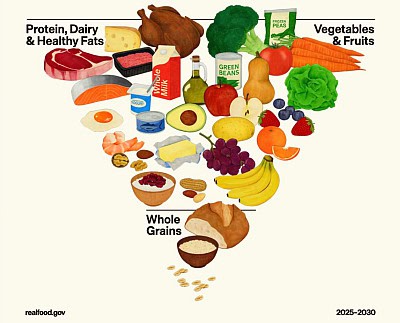
The New Food Pyramid (realfood.gov)
The overarching theme of the new guidelines is: Eat Real Food. The guidelines urge people to focus on eating whole, nutrient-dense foods, including high-quality protein, dairy, vegetables, fruits, healthy fats, and whole grains.
There’s an even greater emphasis than before on limiting added sugars and highly processed foods. They guide us towards healthier foods and away from foods that have high levels of refined carbohydrates, added sugars, excess sodium, unhealthy fats, or artificial flavors, colors and preservatives.
If you’re a parent trying to figure it all out, Nada notes, “many of the recommendations you may be familiar with from the past are still in place.” Prior guidelines also emphasized paying attention to portion sizes, healthy hydration, and building healthy plates with fruits, veggies, fiber rich whole grains, and quality protein.
But Nada points out, “There is a greater emphasis on building healthy habits early, and on recognizing that a healthy eating pattern can look different for every family, depending on culture, traditions, and food preferences.”
And for those who remember the old pyramid, the new one pictures red meat, butter, and full-fat dairy. “That’s a change,” Nada notes. “But it’s the broader message that’s most important,” she adds. The guidelines reinforce that it’s important to prioritize high-quality, nutrient-dense protein foods as part of a healthy dietary pattern.
Broadly that means consuming a variety of protein foods from animal sources, including eggs, poultry, seafood, and red meat, as well as a variety of plant-sourced protein foods, including beans, peas, lentils, legumes, nuts, seeds, and soy.
“One of the key things that the new pyramid highlights is the wide variety of foods that fit into a healthy diet,” Nada says. “Healthy eating is about the overall pattern, not any one thing on the plate.”
Q: What do the guidelines say specifically about children’s diets?
 The guidance breaks down optimal food and nutrition for specific age groups, starting from birth and going up all the way up to age 18.
From birth to six months old, the guidelines call for infants to consume breast milk or iron-fortified infant formula. Formula should stop at 12 months of age, and whole milk introduced.
Infants eating solid food should have nutrient-dense foods in appropriate textures: Fruits and vegetables; whole grains; poultry, seafood, and meat; legumes and nut or seed-containing foods prepared in a safe, infant-appropriate form; and full-fat cheese and yogurt while avoiding nutrient-poor and highly processed foods.
Kids between 5 and 10 should build their diets around protein, dairy, fruits and vegetables, whole grains, and healthy fats, while steering clear of added sugars and caffeinated drinks. Hydration should come from water and unsweetened beverages.
“The guidelines highlight that no amount of added sugar really makes sense for young children,” Nada says. “Added sugar doesn’t provide the benefits that healthy carbohydrates like fruits, vegetables and whole grains do since the natural sugars in these foods come along with fiber and a variety of beneficial nutrients.”
Teens between 11 and 18 are in a phase of rapid growth, bringing greater demands for energy, protein, iron, and calcium. Calcium and vitamin D are especially critical during these years for building peak bone mass.
The guidelines urge this age group to cut back on energy drinks, sugary beverages, and highly processed foods, and to get hands-on in the kitchen and at the grocery store to build lifelong healthy eating habits.
Q: What changed with the new guidelines?
 The guidelines put a much greater emphasis on reducing ultra-processed foods in our diets. Specifically, they recommend:
- Avoiding highly processed packaged, prepared, ready-to-eat, or other foods that are salty or sweet, such as chips, cookies, and candy that have added sugars and sodium (salt).
- Limiting foods and beverages that include artificial flavors, petroleum-based dyes, artificial preservatives, and low-calorie non-nutritive sweeteners; and
- Avoiding sugar-sweetened beverages, such as sodas, fruit drinks, and energy drinks.
The updated guidelines also push the no-added-sugar threshold for children from age 2 to age 11, which marks a significant shift from prior recommendations, and add a new benchmark for everyone else: As part of a healthy or nutritious diet no single meal should contain more than 10 grams of added sugar.
Protein gets a new spotlight as well, with an increase in the recommended amount by about 50% from prior guidelines.
The guidelines retain the decades-old recommendation to limit daily calories from saturated fat to 10 percent of total calories.
Nada notes that schools are already finding ways to provide children the foods they love with less added sugar.
“Kids love things like donuts, and the goal isn’t to cut them out completely—it’s about offering them less frequently—and having options with lower levels of added sugar,” Nada says. “The bigger breakfast opportunity is leading with protein in the morning. Protein, good fats, and fiber-rich carbohydrates are what really help kids focus and stay energized through the day. Kids still need carbs for energy—but with a focus on the good kind, like whole grains.”
And when it comes to sweets for young children, the “occasional, not every day” approach applies at home, too. A birthday cake is a treasured tradition—but it’s better to enjoy the cake at the party, instead of making cake, cookies, or sugary cereal part of every day.
Q: Do the guidelines and food pyramid give me all the information I need, or are there times when extra information and support might be needed?
 The new guidelines and pyramid provide a foundation, but they’re far from the whole story for many families. A one-size-fits-all framework has its limits. Even a seemingly straightforward question, like whether whole milk or reduced fat milk is right for your school-aged child, often calls for personalized advice that a federal chart can’t provide. The need for individualized guidance is even more important when children face complex health needs.
For example, managing a chronic condition like Type 2 Diabetes or navigating food allergies requires guidance that goes well beyond general recommendations. Also, families experiencing food insecurity may need help from a healthcare provider to connect with programs to ensure their children have reliable access to nutritious food.
When guidelines aren’t enough, a pediatrician or a registered dietitian can fill the gap by working one-on-one with families to build an approach that fits their child’s specific health, circumstances, and lifestyle.
Q: What about artificial colors and additives?
 The new guidelines highlight ultra-processed foods and ingredients and specifically mention artificial flavors, colors, and preservatives. Nada notes that this can seem intimidating to parents, but that by choosing whole, nutrient-dense foods, parents will be taking the most important step towards reducing the amount of these additives.
“It’s one of the things that’s so positive about the ‘eat real food’ approach,” Nada says. “By consuming more nutritionally dense whole foods you and your children naturally get more of the things we want and less of the things we don’t want from the food we eat.”
Nada noted that for school menus, Aramark Student Nutrition has been advancing menus with less added sugar, lower sodium, more whole grains, and fewer artificial ingredients for several years. For the upcoming 2026–2027 school year, she highlighted that menus for schools participating in the National School Lunch Program go even further—removing many additives and artificial dyes totally (read more here).
When Nada builds a local school menu, she ensures that every calorie, saturated fat, and sodium target from the National School Lunch Program is met. And in 2027, an added-sugar target will be added to that list, too.
Menus also have to hit specific requirements across grains, meat, and vegetable groups like dark green, red and orange, beans, and starchy vegetables. “That’s actually an important advantage of school meals,” Nada notes. “There’s already a team of experts checking that school meals line up with the guidelines.”
Q: What does a “good” meal actually look like, day to day?
 “Keep it simple,” Nada says, encouraging parents to “start with protein, healthy fat, and fiber-rich carbohydrates and build meals around these basics, for your children’s health and yours, too!”
Good protein sources include lean meats, fish, chicken, eggs, and plant-based options like legumes, beans, chickpeas, and lentils. Greek yogurt is another favorite. “It’s a great source of protein, as long as it doesn’t have much added sugar mixed in,” Nada says.
She recommends peanut butter without added sugar and for healthy fats, she points to nuts like walnuts and almonds, avocado, and olive or avocado oil for cooking. A typical breakfast in her house might be eggs, Greek yogurt, or a Middle Eastern-style dish like hummus with fava beans, which covers protein and fiber at once.
Q: What are some other great resources for nutrition guidance to help parents?
 Beyond the pyramid, several trusted organizations offer science-backed guidance tailored to children and families. The American Academy of Pediatrics has extensive nutrition resources for parents at healthychildren.org, covering everything from infant feeding to teen eating habits.
The Academy of Nutrition and Dietetics at eatright.org can help families find a registered dietitian in their area. For families navigating food insecurity, the USDA’s WIC program and local food banks connected through Feeding America are good starting points. And for children with chronic conditions, organizations such as the American Diabetes Association or FARE for food allergies, also offer condition-specific dietary guidance.
Nada, who spent five years working at a WIC office, says she still frequently refers families there.
“WIC provides food and nutrition education for children from birth to age five,” she says. “Food banks and pantries help, too, though they work a little differently. SNAP gives families a card with funds based on income to use for groceries each month, while pantries usually provide food directly, often canned goods, but not necessarily on a guaranteed monthly basis.”
Q: Are there any areas in the new guidelines where experts disagree?
 Like any major policy document, the 2025–2030 Dietary Guidelines have sparked some debate among nutrition experts, particularly around the addition of full-fat dairy and red meat to the new pyramid, while the guidelines still recommend limiting saturated fat to 10% of daily calories or less.
But Nada encourages parents to not be distracted by disagreements that they may hear about.
“When you focus on the day-to-day reality of feeding children well, the essentials are solid and clear and experts are in agreement,” says Nada.
The new pyramid reinforces a fundamentally healthy approach of building meals and snacks from whole, minimally processed foods; prioritizing quality protein, vegetables, fruits, and fiber rich whole grains; and limiting added sugars, sodium and unhealthy fats.
Nada also notes that if there are areas where you have questions or have heard something that conflicts with the guidelines or pyramid, it’s best to talk your pediatrician or a dietitian who specializes in childhood nutrition.
Nada Krayem is a Registered Dietitian and part of Aramark’s Nutrition Network—a community of dietitians within Aramark Student Nutrition. The Nutrition Network connects and engages Aramark Student Nutrition RDNs and other nutrition experts in ways that benefit school students, parents and caregivers, and their district’s health and wellbeing initiatives.
Note: Since everyone’s health history and nutritional needs are so different, please make sure that you talk with your doctor and a registered dietitian to get advice about the diet and exercise plan that‘s right for you.